For viscous liquid filling, piston filling is generally the stronger choice when manufacturers need controlled, repeatable doses of products such as sauces, honey, shampoo, lotion, cream and liquid detergents. Peristaltic filling is often more suitable for smaller filling volumes, sensitive formulations or applications where the product should contact only the inside of the pump tubing. The right choice depends on viscosity, product consistency, hygiene requirements, filling volume, accuracy expectations and production output—not simply which technology is faster.
For manufacturers comparing industrial filling machines, understanding this difference helps avoid selecting equipment that performs well with water-like liquids but struggles with thicker products. EPK Packingline focuses on piston-based bottle filling solutions, including the LF-2 Double-Head Servo Piston Filling Machine and LF-10 Automatic 10-Head Piston Filling and Capping Machine. These models provide practical options for different production scales and viscous liquid applications.
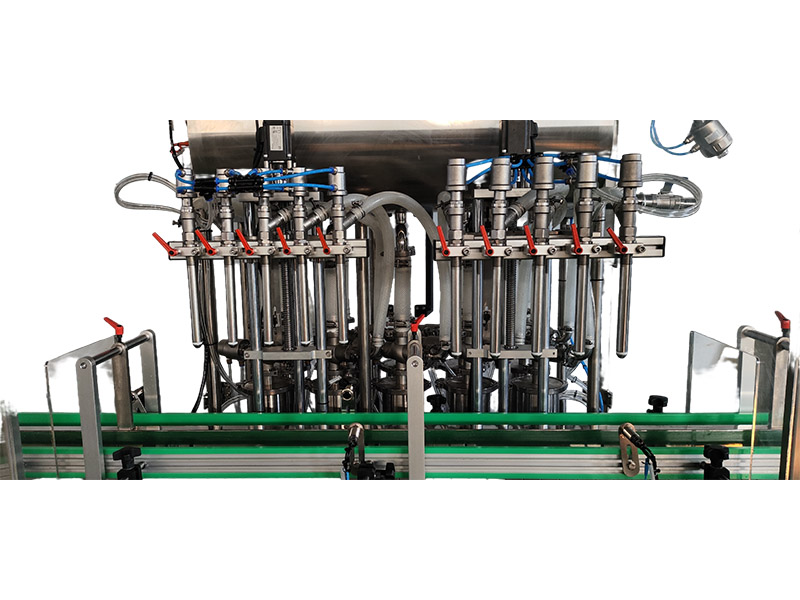
How Piston and Peristaltic Filling Systems Work
A piston filling machine uses a cylinder and piston to draw a measured quantity of product into a chamber and then dispense it through a filling nozzle. The piston movement controls the dispensing volume, while the filling parameters can be adjusted to suit the product and container. Servo-driven piston systems offer controlled movement and adjustable filling settings, making them suitable for many medium- to high-viscosity liquids.
A peristaltic filling machine works differently. Rollers or another compression mechanism press flexible tubing in sequence, moving liquid through the tube toward the filling nozzle. The product normally contacts the inside of the tubing rather than the pump's mechanical components. This arrangement can be useful for small-dose filling and applications where product-contact separation is important. However, tubing compatibility, wear, replacement frequency and product flow characteristics must be considered.
Neither technology is automatically suitable for every viscous liquid. A thick product may require a larger flow passage, an appropriate pump arrangement and a controlled filling speed. The actual formulation should be tested using the intended container and filling volume before equipment selection is finalised.
Piston vs Peristaltic Filling: Key Differences
The following comparison summarises common engineering considerations. It is a general technology comparison, not a claim that every machine of either type has identical performance.
| Selection factor | Piston filling | Peristaltic filling |
|---|---|---|
| Operating principle | Measured product displacement by a piston and cylinder | Liquid movement through sequential compression of tubing |
| Viscous products | Commonly used for sauces, honey, creams, lotions and other thicker liquids | Depends strongly on viscosity, tubing diameter and pump capability |
| Product contact | Product contacts the filling cylinder, seals and product passages | Product primarily contacts the inside of the pump tubing and delivery path |
| Typical application focus | Bottle filling with repeatable, measured doses | Small-dose or product-contact-sensitive dispensing applications |
| Main maintenance consideration | Cylinder, piston seals, valves and product-contact cleaning | Tubing compatibility, compression wear and replacement |
| Important purchasing question | Can the piston system handle the product and required filling volume? | Can the tubing and pump deliver the product consistently at the required rate? |
For many bottle-filling projects involving thicker products, a piston system is a practical starting point because it is designed around measured product displacement. Peristaltic systems may be attractive where tubing-based product contact is a priority, but they should not be selected without checking whether the product can move reliably through the proposed tubing at the required output.
Which Filling Method Is Better for Different Viscous Products?
Product names alone are not enough to determine the filling method. Two shampoos or sauces can behave differently because of their formulations, temperature, suspended ingredients and viscosity. Buyers should therefore provide actual product information rather than asking a supplier to recommend a machine based only on a broad category.
| Product type | Technology to evaluate first | What buyers should verify |
|---|---|---|
| Honey and thick sauces | Piston filling | Product flow, nozzle size, filling volume and cleaning method |
| Shampoo and liquid soap | Piston filling or a tested alternative | Foaming behaviour, viscosity, dripping and container-neck cleanliness |
| Creams and lotions | Piston filling; assess peristaltic for suitable small-dose applications | Texture, product sensitivity, dose size and tubing or seal compatibility |
| Low-volume sensitive liquids | Peristaltic filling may be worth evaluating | Tubing material, dose repeatability, cleaning and replacement cost |
| Products with suspended particles | Application-specific evaluation | Particle size, nozzle passage, blockage risk and product damage |
For thick sauces, honey, shampoo, lotion and liquid soap, EPK's published piston-filling applications provide a relevant starting point. The EPK Filling and Capping Machines category includes automatic and semi-automatic bottle-filling configurations for liquid and viscous products. The final selection should still be validated using the actual product.
EPK LF-2: Flexible Piston Filling for Smaller Production Batches
The EPK LF-2 Double-Head Servo Piston Filling Machine with Semi-Automatic Capping combines two servo-controlled piston filling heads with a semi-automatic capping arrangement. EPK describes it as a flexible solution for small and medium production batches, product changes and manufacturers that do not require a fully automated bottling line.
The filling volume is customised according to customer requirements, and filling speed is related to the selected volume. Its published specifications include a 380 V, three-phase, 50–60 Hz power supply and 4 kW power consumption. The listed filling-machine dimensions are 2000 × 1000 × 1700 mm, while the capping-machine dimensions are 2000 × 700 × 1700 mm.
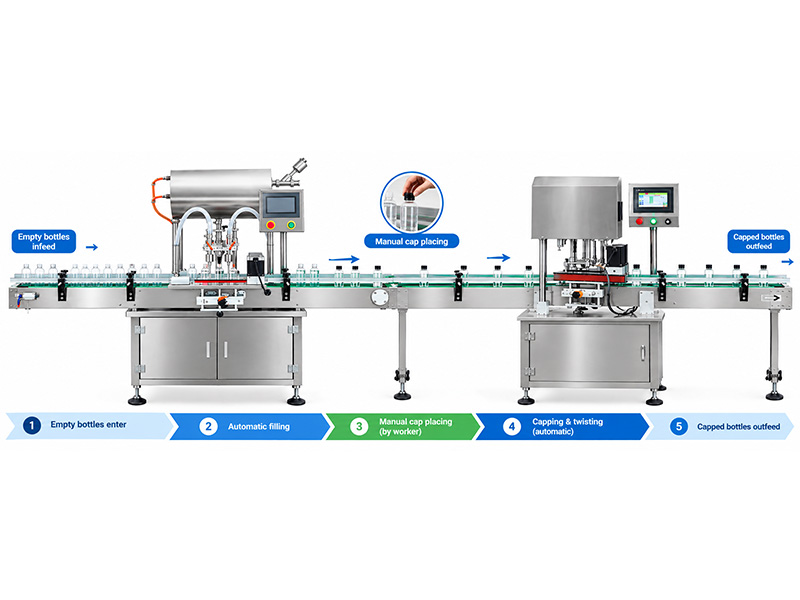
For manufacturers handling multiple bottle formats or moderate production volumes, the LF-2 offers a practical balance between automated filling and operator-assisted capping. Buyers should confirm the compatible product range, nozzle arrangement and filling-volume range with EPK before ordering.
EPK LF-10: Multi-Head Automatic Piston Filling and Capping
For more integrated bottle production, EPK offers the LF-10 Automatic 10-Head Piston Filling and Capping Machine. It combines ten servo piston filling heads with automatic cap sorting, feeding and capping. The published features include PLC and touchscreen control, servo parameter memory, a high-level hopper with level control and a one-click cleaning function.
EPK also specifies PTFE food-grade seals and filling heads that can be equipped with anti-drip sealing and collection trays according to product characteristics. These details are relevant when evaluating product compatibility and cleaning. They should not, however, be interpreted as a universal guarantee of compatibility with every viscous formulation.
The LF-10 has a published power consumption of 6 kW and requires a 220 V, single-phase, 50–60 Hz electrical supply and an air supply of at least 0.6 MPa. Its filling volume is customised, while filling speed depends on the selected volume. EPK lists applications including sauces, honey, jam, edible oil, beverages, shampoo, lotion, cream, liquid soap, detergents, lubricants and other compatible liquids.
EPK LF-2 vs LF-10: Published Technical Specifications
| Specification | LF-2 | LF-10 |
|---|---|---|
| Filling heads | 2 servo piston heads | 10 servo piston heads |
| Capping | Semi-automatic | Automatic cap sorting, feeding and capping |
| Filling volume | Customised | Customised |
| Filling speed | Depends on filling volume | Depends on filling volume |
| Power supply | 380 V, 3-phase, 50–60 Hz | 220 V, single-phase, 50–60 Hz |
| Power consumption | 4 kW | 6 kW |
| Air supply | Not specified on product page | At least 0.6 MPa |
| Filling machine dimensions | 2000 × 1000 × 1700 mm | 2400 × 1000 × 1900 mm |
The comparison shows that LF-2 and LF-10 differ in filling-head count, capping automation, electrical requirements and machine dimensions. The ten-head configuration is designed for a more automated workflow, but the actual production rate still depends on the product, filling volume, bottle handling and operating conditions. EPK should confirm the expected output for the buyer's specific application.
What Should Buyers Confirm Before Choosing a Filling Machine?
Before requesting a quotation, prepare the product and packaging information that determines the machine configuration. Include the liquid's viscosity or a representative sample, product temperature, whether it contains particles, the target filling volume, bottle dimensions and required production output. Also explain whether the product is sensitive to shear, aeration or contact with particular materials.
Ask the supplier to clarify the filling-volume range, nozzle options, product-contact materials, cleaning procedure, changeover requirements and compatibility with the proposed bottle. For peristaltic systems, tubing material and replacement intervals should be included in the evaluation. For piston systems, confirm seals, valves, cylinder cleaning and the suitability of the product passage for the formulation.
Most importantly, request a filling trial using the actual product wherever possible. A successful test should assess dose consistency, filling time, dripping, product residue, cleaning and the performance of the complete filling and capping process. This provides a much stronger basis for investment than comparing machine descriptions alone.
Frequently Asked Questions About Piston and Peristaltic Filling
Is piston filling better for viscous liquids?
Piston filling is commonly used for thicker products such as honey, sauces, creams, lotions and shampoo because it dispenses a measured volume through a piston-and-cylinder system. Actual suitability depends on viscosity, product consistency and machine configuration.
Is peristaltic filling suitable for thick liquids?
It can be suitable for some products, but performance depends on viscosity, tubing diameter, pump capability and required flow rate. Very thick products may require a different pumping arrangement.
Which filling method is more hygienic?
Peristaltic systems can limit product contact to the inside of the tubing, while piston systems have product-contact cylinders, seals and passages that must be cleaned appropriately. Hygiene depends on the complete machine design, materials and validated cleaning procedure.
Does EPK offer peristaltic filling machines?
EPK's currently verified bottle-filling product pages feature piston-based LF-2 and LF-10 machines. A peristaltic filling model is not identified in the product information reviewed for this article. Buyers requiring peristaltic technology should confirm availability directly with EPK.
Which EPK model is suitable for viscous liquid production?
The LF-2 and LF-10 are both piston-filling configurations listed for liquid and viscous product applications. LF-2 uses two servo piston heads with semi-automatic capping, while LF-10 uses ten servo piston heads with automatic cap sorting, feeding and capping. The best choice depends on output requirements and packaging specifications.
Can EPK customise the filling volume?
Both LF-2 and LF-10 product pages state that filling volume is customised according to customer requirements. Confirm the required range and product compatibility with EPK before placing an order.
Find the Right Viscous Liquid Filling Solution with EPK Packingline
Piston and peristaltic filling technologies solve different production needs. For manufacturers filling sauces, honey, shampoo, lotion, cream and other viscous liquids into bottles, a servo piston system is often a practical technology to evaluate. EPK Packingline offers the LF-2 double-head and LF-10 ten-head piston filling configurations for different levels of production automation.
Send EPK your product details, bottle dimensions, target filling volume and required output. If possible, provide a product sample or video of the current filling process. EPK can then review the application and discuss a suitable filling and capping configuration for your production line.