The minimum rolling diameter of a 4-roll plate rolling machine is one of the most important technical parameters in plate forming applications. It directly affects whether a machine can produce small-diameter cylinders, tight-radius sections, or high-curvature components required in advanced fabrication industries.
However, the minimum achievable diameter is not determined by a single factor. It depends on the interaction between:
- Roll geometry
- Plate thickness
- Material yield strength
- Machine structure
- Forming method
- Residual springback characteristics
This article explains the engineering principles behind minimum rolling diameter calculation and the limitations of 4-roll plate rolling machines in real industrial applications.
What Does “Minimum Rolling Diameter” Mean?
The minimum rolling diameter refers to:
The smallest internal cylinder diameter that a rolling machine can form while maintaining acceptable geometric accuracy and material integrity.
This parameter is typically specified under standard conditions:
- Mild steel material
- Standard yield strength (~245 MPa)
- Full-width rolling
- Cold forming process
Why Minimum Diameter Matters
Smaller rolling diameters are required in applications such as:
- Pressure vessel nozzles
- Pipe sections
- Heat exchanger shells
- Ventilation ducts
- Cone transitions
- Compact cylindrical structures
Achieving small diameters requires significantly higher localized deformation, which increases the demands on machine rigidity and rolling force.
Main Factors Affecting Minimum Rolling Diameter
1. Upper Roll Diameter
The most critical factor is the diameter of the top roll.
Engineering Principle
A rolled plate cannot normally achieve a radius significantly smaller than the top roll radius without excessive deformation or instability.
In general:
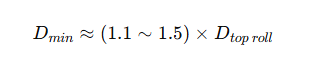
Where:

Example
If the upper roll diameter is:
300 mm
Then the minimum rolling diameter is approximately:
330–450 mm
depending on material and thickness.
2. Plate Thickness
Thicker plates are more difficult to deform into tight radii.
Relationship
As thickness increases:
- Required bending moment increases exponentially
- Internal stress increases
- Springback becomes larger
This increases the achievable minimum diameter.
Engineering Trend
|
Plate Thickness |
Minimum Achievable Diameter |
|
Thin plate |
Smaller diameter possible |
|
Thick plate |
Larger minimum diameter |
3. Material Yield Strength
Higher-strength materials resist deformation more strongly.
Examples:
|
Material |
Rolling Difficulty |
Rolling Difficulty |
|
Mild steel |
~245 MPa |
Low |
|
Stainless steel |
~520 MPa |
Medium |
|
High-strength steel |
>700 MPa |
High |
Higher yield strength causes:
- Increased springback
- Higher forming force requirements
- Larger minimum achievable diameter
4. Side Roll Geometry and Movement
In a W12 4-roll machine:
- Side rolls control plate curvature
- Roll positioning accuracy directly affects small-radius forming
Machines with:
- Independent hydraulic side roll control
- High-precision synchronization
- CNC compensation systems
can achieve tighter diameters more accurately.
5. Residual Springback
Springback occurs when the material partially returns toward its original shape after unloading.
Important Impact
For small-diameter rolling:
- Springback becomes more significant
- Final diameter may increase after release
Therefore, operators must apply:
- Over-bending compensation
- CNC correction algorithms
to achieve the target diameter.
Simplified Engineering Estimation Formula
A practical estimation formula used in plate rolling is:
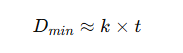
Where:
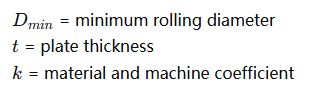
Typical values:
|
Material Type |
k Value |
|
Mild steel |
20–30 |
|
Stainless steel |
30–40 |
|
High-strength steel |
40–50 |
Example Calculation
Given
- Mild steel plate
- Thickness: 10 mm
- Coefficient: 25
Estimated minimum diameter:
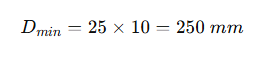
This provides a preliminary engineering estimate.
Difference Between Theoretical and Actual Minimum Diameter
In practice, actual rolling diameter is influenced by:
- Operator experience
- CNC control precision
- Plate edge condition
- Friction coefficient
- Machine wear condition
Therefore:
Actual achievable diameter is often slightly larger than theoretical calculations.
Pre-Bending Limitations
One critical limitation is pre-bending.
Even if the machine can roll a small diameter in the center section:
- Plate edges may remain flat
- Additional calibration may be required
4-roll machines reduce this issue because they support:
- Continuous clamping
- Improved edge pre-bending capability
Advantages of 4-Roll Machines in Small Diameter Rolling
Compared to 3-roll machines, 4-roll systems offer several technical advantages:
Better Plate Stability
Continuous clamping reduces slippage during high-curvature forming.
Higher Precision
Independent roll control improves curvature consistency.
Improved Pre-Bending
Smaller flat-end sections can be achieved.
Better CNC Integration
Automated compensation improves small-radius accuracy.
CNC Compensation for Small Diameter Rolling
Modern CNC systems can automatically adjust:
- Roll position
- Pressure distribution
- Over-bending amount
based on:
- Material database
- Plate thickness
- Target diameter
This greatly improves repeatability for tight-radius rolling.
Industrial Applications Requiring Small Rolling Diameters
Industries requiring small-diameter rolling include:
- Heat exchanger manufacturing
- Aerospace components
- Precision duct systems
- Pharmaceutical equipment
- Food-grade stainless steel fabrication
- High-pressure piping systems
These applications demand high geometric accuracy and surface quality.
Why Choose ZYCO 4-Roll Rolling Machines?
Modern ZYCO 4-roll plate rolling machines are engineered for high-precision rolling applications, including tight-radius forming.
Key technical advantages include:
- High-rigidity machine structure
- Precision hydraulic synchronization
- Advanced CNC compensation systems
- Optimized roll geometry
- Stable small-diameter rolling performance
These features help manufacturers achieve reliable rolling quality with improved efficiency and reduced setup time.
Conclusion
The minimum diameter a 4-roll plate rolling machine can achieve depends on multiple engineering factors, including:
- Roll diameter
- Plate thickness
- Material yield strength
- Machine rigidity
- CNC control capability
In general:
Smaller upper rolls, thinner materials, and advanced CNC compensation systems allow tighter rolling diameters.
For manufacturers requiring high-precision small-radius rolling, selecting a properly configured CNC 4-roll rolling machine is essential for achieving stable, repeatable, and high-quality forming results.